|
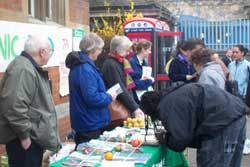
People
were asked to enjoy delicious fresh organic food donated by member
of the local group, local box schemes; (The Organic Delivery Company,
Farmaround) Black and Green and Bushwhackers foods and learnt
more about the food they enjoy eating everyday, where it comes
from and how that effects you, other people and the environment.
People also signed a petition to support the bite back campaign.
This is a response to the US attempt to force feed GM crops to
UK consumers via the World Trade Organisation. The campaign invites
people to make their own legal submission to the WTO, urging them
to dismiss the US complaint.
Paula White, from Hammersmith and Fulham Friends of the Earth,
says: "The change towards organic food consumption can not
only help to improve our health and that of our families and friends,
it also brings great benefits to farm animals, wildlife, the countryside
and the environment as a whole. Supermarkets are not always the
best or cheapest choice. The box schemes make some of the best
value buys with locally produced organic food delivered to your
door frequently at a much cheaper price than the supermarket".
HFFOE
Web site
Ten
Reasons to Eat Organic
1. It's healthy
On average, organic food contains higher levels of vitamin C and
essential minerals such as calcium, magnesium, iron and chromium
as well as cancer-fighting antioxidants.
2. No nasty additives
Organic food doesn't contain food additives which can cause health
problems such as heart disease, osteoporosis, migraines and hyperactivity.
Amongst the additives banned by the Soil Association are hydrogenated
fat, aspartame (artificial sweetener) and monosodium glutamate.
3. Avoids pesticides
Over 400 chemical pesticides are routinely used in conventional
farming and residues are often present in non-organic food. The
UK government has recently found high levels of pesticide residues
in baby food, spinach, dried fruit, bread, apples, celery, and
chips.
4. GM-free
Genetically modified (GM) crops and ingredients are not allowed
under organic standards.
5. Reliance on drugs removed
There is growing concern about the high use of antibiotics on
farm animals and the possible effects on human health. Soil Association
standards prohibit the routine use of antibiotics.
6. No hidden costs
Compare this with the £120m that tax payers fork out to
pay for chemicals to be removed from drinking water, mainly as
a result of the pesticides used in farming.
7. High standards
Organic food comes from trusted sources. All organic farms and
food companies are inspected at least once a year. The standards
for organic food are laid down in European law.
8. Care for animals
Animal welfare is taken very seriously under organic standards
and is supported by animal rights organisations such as Compassion
in World Farming as well as the UK government.
9. Good for wildlife and the environment
The UK government has said that it is better for wildlife, causes
lower pollution from sprays, produces less carbon dioxide - the
main global warming gas - and less dangerous wastes.
10. Top for taste
Many people prefer organic food because they say it tastes better.
A number of top chefs choose organic, and every year many are
involved in the Soil Association's Organic Food Awards.
Go
local: 10 reasons why
1.
Encourages quality healthy eating with freshly-picked seasonal
fruit and vegetables as well as local specialities
2.
Reduces processing and packaging
3.
Supports organic and low-input agriculture thus enriching biodiversity
and wildlife
4.
Kinder to animals by decentralising the distribution system thus
reducing live animal transport and and hindering the development
of national disease epidemics like foot and mouth
5.
Boosts rural economy - latest research from the New Economic Foundation
shows that money spent on locally-produced food generates almost
twice as much income for the local economy as the same amount
spent in a typical supermarket
6.
Ensures farmers' fair share by avoiding the middleman
7.
Creates better understanding between town and country and helps
support improvements in farming
8.
Cuts down on air miles, the least environmentally-friendly form
of transport
9.
Nurtures identity of local community
10.
Develops food culture - food is no longer anonymous but comes
with a local story - customer knows where produce came from, what
variety/breed it is
HFFOE
Real Food Directory
April 02, 2004
|