H&F Council Report Signals Change of Policy on Hammersmith Bridge
Recommends not bidding for full reopening from Structures Fund
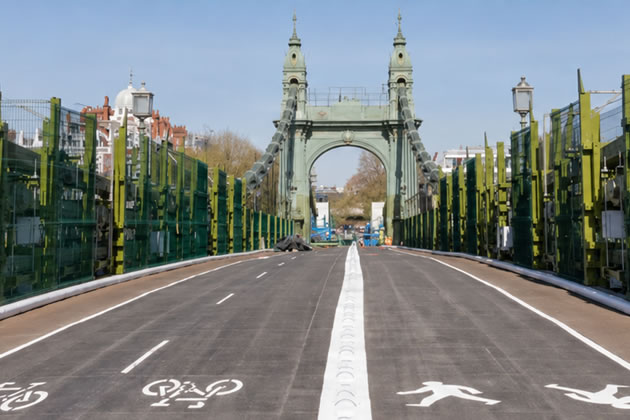
Council officers warn that even funding keeping the bridge open to non-motor traffic is challenging. Picture: H&F Council
June 30, 2026
Hopes that the funding for a reopening of Hammersmith Bridge to motor traffic appear to be receding with a new internal report recommending that the borough should not pursue this option.
Hammersmith & Fulham Council officers have detailed in the report the financial gulf standing between the 139-year-old crossing and a full restoration and concluded that the borough simply doesn’t have the financial resources to contribute to the cost.
The report, to be considered by the Council's cabinet on Monday 7 July, reveals that a complete restoration of the Grade II* listed suspension bridge — enough to allow motor traffic to return — would now cost £300m, a sum that is simply beyond the reach of the local authority.
It had been hoped that the Department for Transport’s (DfT) Structures Fund which was offering £1billion to spend on repairing infrastructure across the country could provide the funding needed.
Instead, the council is recommending a more limited "phased repair" approach in its bid to the fund, focused on the most critical life-expired elements of the structure. The aim would be to keep the bridge open to pedestrians, cyclists and river traffic, rather than restore the full access that many local residents and businesses have long demanded.
The report will come as a disappointment for those hoping that Hammersmith Bridge will reopen to motor traffic.
Fleur Anderson said she was 'deeply disappointed' with the change of direction from council and acknowledged that it was that it was unreasonable to expect Hammersmith & Fulham Council to bear additional financial burdens after investing £54 million to ensure the safety of the bridge.
However she added, "The Council’s report fails to address the six bus routes that have been cut and the significant daily consequences for residents in Roehampton and Putney.
"The travel experience through Putney is severely affected by the closures of both Hammersmith and Albert Bridges, leading to frequent gridlock on routes into Putney High Street. Commuters are facing prolonged bus delays, making travel frustrating and unreliable for thousands of people every day.
"I will continue to advocate for the complete restoration of Hammersmith Bridge. The Government must urgently explore alternative budget allocations to reinstate this vital transport route in our capital city. Transport for London must also take more action to prevent bus delays and early service terminations, while addressing the growing congestion on our roads."
She also commented that, given the ever-increasing restoration costs, alternative cheaper crossings should also be considered.
Hammersmith Bridge first opened in 1887, making it London's oldest surviving suspension bridge over the Thames. Its unusual construction — primarily wrought iron, supported by cast iron pedestals — has made it both a cherished landmark and an engineering headache. Cast iron can fail suddenly, making the bridge the weakest of London's bridges designated for vehicular traffic, and its upkeep far more expensive than other crossings.
The bridge closed to motor vehicles in April 2019 after hairline micro-fractures were detected in its four cast iron pedestals. The situation deteriorated dramatically in August 2020 when, following a five-day heatwave, the cracks widened rapidly, creating a risk of imminent collapse. The bridge was evacuated and closed to pedestrians entirely.
A stabilisation programme eventually allowed the bridge to reopen to pedestrians and cyclists in July 2021, and, following the completion of further pedestal works, the main deck fully reopened to pedestrians and cyclists in April 2025.
The council has spent £54m on the bridge since its full closure in 2019, covering stabilisation works, safe operation and preparatory restoration work. A further £4m, funded by the Department for Transport (DfT), is expected to be spent on permanent repairs to the central hangers, bringing the total forecast expenditure to £58m.
To put that figure in context, the report notes that between 2010 and 2021, all London councils together spent just £100m on the maintenance and repair of all London road and river bridges — and most of that money was ultimately paid by TfL or the Government.
In June 2021, an equal three-way funding split was agreed in principle between Hammersmith & Fulham, the DfT and TfL. But the Memorandum of Understanding that would have formalised this arrangement was never signed. To date the council has received just £15.96m in contributions from the DfT and TfL combined — against a target of £38.89m. The report states that the council is owed a further £22.9m: £6.4m from the DfT and £16.5m from TfL.
The council has always maintained that it could fund its one-third share only if it were able to recover the money through a road user charge or toll once the bridge reopened to vehicles. The phased repair approach now being pursued would rule that out — at least for the foreseeable future.
The only new funding available, according to the report, is through a £1bn Structures Fund announced by the Government in June 2025 as part of its 10-Year Infrastructure Strategy. The DfT has indicated that Hammersmith Bridge would be a "good candidate" for the fund.
However, the fund comes with significant constraints. All works must be completed by 31 March 2030 — a deadline that, according to council officers, rules out full restoration, which cannot be delivered in that timeframe. Applications from highway authorities across England are expected to be highly competitive, and proposals that include a higher local funding contribution will be assessed more favourably.
The council has submitted a pre-application for works estimated at £128m, covering the most at-risk elements of the bridge, including the reinstatement of the ornate cast iron pedestal casings that were removed during stabilisation works. A full application is due by 3 August, with funding decisions expected in autumn 2026.
If the bid succeeds in full, officers believe it could keep the bridge open to pedestrians, cyclists and river traffic for the foreseeable future and remove the immediate financial burden from the council. If it fails — or if the award falls significantly short — the council faces annual maintenance and inspection costs of around £1.5m simply to keep the bridge open and safe as a substandard structure.
A separate complication involves the bridge's ornate cast iron pedestal casings, which were removed in 2020 at a cost of around £10m — funded by TfL — to enable the stabilisation works. They have been in storage ever since, costing the council approximately £120,000 a year.
Historic England agreed to their temporary removal on the clear expectation that they would be reinstated. Planning consent for their removal has now lapsed, and a decision is awaited on an application to extend consent for a further five years. The council warns that if no reasonable prospect of repair exists by the time any extended consent expires, further consent could be refused.
The cabinet report asks members to endorse phased repair as the council's current strategic approach, and to confirm that any future decision about restoring motor traffic to the bridge must be based on an objective assessment of transport need — including traffic flow data.
The report notes that traffic modelling carried out since the bridge's closure to motor vehicles has produced ambiguous results. Vehicle counts on neighbouring bridges — Kew, Chiswick, Wandsworth and Putney — have in fact fallen since 2018, rather than rising as might be expected if Hammersmith Bridge traffic had displaced elsewhere.
Cabinet approval would be required before any steps are taken to pursue funding for strengthening that would permit motor vehicles to return.
The bridge, the report warns, remains in a fragile condition. Without significant investment, it is likely to have to close again on safety grounds "in the short to medium term."
Like Reading Articles Like This? Help Us Produce More This site remains committed to providing local community news and public interest journalism. Articles such as the one above are integral to what we do. We aim to feature as much as possible on local societies, charities based in the area, fundraising efforts by residents, community-based initiatives and even helping people find missing pets. We’ve always done that and won’t be changing, in fact we’d like to do more. However, the readership that these stories generates is often below that needed to cover the cost of producing them. Our financial resources are limited and the local media environment is intensely competitive so there is a constraint on what we can do. We are therefore asking our readers to consider offering financial support to these efforts. Any money given will help support community and public interest news and the expansion of our coverage in this area. A suggested monthly payment is £8 but we would be grateful for any amount for instance if you think this site offers the equivalent value of a subscription to a daily printed newspaper you may wish to consider £20 per month. If neither of these amounts is suitable for you then contact info@neighbournet.com and we can set up an alternative. All payments are made through a secure web site. One-off donations are also appreciated. Choose The Amount You Wish To Contribute. If you do support us in this way we’d be interested to hear what kind of articles you would like to see more of on the site – send your suggestions to the editor. For businesses we offer the chance to be a corporate sponsor of community content on the site. For £30 plus VAT per month you will be the designated sponsor of at least one article a month with your logo appearing if supplied. If there is a specific community group or initiative you’d like to support we can make sure your sponsorship is featured on related content for a one off payment of £50 plus VAT. All payments are made through a secure web site. |