Local Tories Launch Election Manifesto
Pledge a reduction in waste and needless bureaucracy
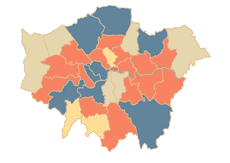
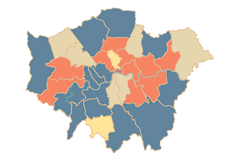
A report on the forthcoming London Borough elections has made a series of detailed predictions on the results. They are predicting at a local level that Labour control will continue in both Hounslow and Ealing with Hammersmith and Fulham falling to the Conservatives.
The report is by the London Communications Agency (LCA), a specialist communications consultancy focusing on London and London issues, and Tony Travers of the London School of Economics (LSE). The predictions are based on 'a combination of top-line analysis of each borough, current national political trends, and gut instinct.'
London’s 32 boroughs are currently controlled by Labour, with 15, the Conservatives with 8, the Liberal Democrats
with 3 and 6 are in No Overall Control (NOC). The report predicts that Labour will end with only 10 boroughs and the Conservatives will win six on top of the eight they already control. LCA have committed to pay £250 to St. Mungo's Hospital for each borough prediction that they get wrong.
The report is predicting that Hammersmith and Fulham will fall to the Conservatives with David Cameron's style of politics and its appeal to middle class voters in the area being decisive and thus 'guarantees' a win for his party. The Conservatives have only taken control of Hammersmith and Fulham once in the last 40 years despite doing relatively well in parliamentary elections. In the past three contests however, the party has narrowed the Labour lead taking it down to only 12 in 2002, of which many are wafer thin majorities. The victory by Greg Hands in the general election is seen as indicating the trend of voting and the issue of health services in the borough is also likely to be a factor. The report names Addison, Fulham Broadway, Fulham Reach, North End, Ravenscourt Park and Sands End wards as providing likely gains for the Tories.
However, the Labour party is unlikely to give up the borough without a fight. The Council was rated 'excellent' by the Audit Commission and they have recently pledged to freeze Council Tax for three years. It is expected that the borough will be a key battleground with all the major party leaders visiting the area before polling day.
Despite the ruling Labour group only needing to lose 7 seats before they give up their majority in the Council, the prediction is that they will retain control of Hounslow. The report mentions the historic poor performance of the Conservatives in "a suburban borough where their policies should arguably have more of an impact on the electorate" and highlights that the Liberal Democrats in the last election got a smaller proportion of the vote than independent parties and the Greens combined. Labour's number of seats has fallen to 36 in 2002 from 49 in 1994 but even given a revived Conservative party and encouraging indications for the opposition in the General Election, where there were significant swings away from Ann and Alan Keen who represent the borough's two Westminster seats, London Communications is still not predicting Labour losing control.
Bedfont, Hanworth Park, Hounslow South and Syon are mention as key marginal seats with 8 that could be potentially lost by Labour. However, with no ABeeC representative standing in Brentford this time around Labour will be hopefully of gaining one seat there. Crime, Heathrow and issues relating to development matters and housing are said to be the key issues in the borough.
They say that Ealing Council has an outside chance of switching to 'no overall control'. Currently Labour hold 46 seats, against 17 for the Conservatives, 4 for the Liberal Democrats (three of which are in Southfield ward) and two others. They highlight East Acton of one of 4 key marginal wards where the Conservatives could expect to gain at least 5 extra seats. However, despite the issue of the tram and what the report describes as the 'more responsive' local Tories there would have to be a major swing against Labour for there to be a losss of overall control. Labour has a high level of support in parts of the borough; three of the top five Labour voting wards in London in 2002 were in Ealing.
The report highlights a trend for voters in London to be 'anti-incumbent' with a tendency to vote against the party in power nationally. They say this factor alone will mean a reduction in the number of Labour controlled Councils.
Another factor has been the ongoing reduction in turnout at elections. In 1990 the turnout was 46%, in 1998 it was 34.6% and by 2002 it had dropped to 31.6%. The Government has recently launched a campaign to encourage the estimated 500,000 unregistered London residents to sign up, but if they do and don’t vote then the percentage turnout will be even lower.
David Cameron would have a very good chance of winning the next election if he could win the 'bell weather' borough of Ealing which has traditional been controlled by the party that goes onto win the next General Election. One factor that could help the Conservatives, according to the report, is their more convincing approach to attraction ethnic minority votes. The Tories have made a much greater effort to field candidates that reflect more closely the areas they are likely to represent particularly in West London.
The LCA describes the elections as the most important for at least 20 years and says the outcome will send out important signals for the main parties in the next general election.
April 5, 2006
Related links
| Related Links | |
Election Maps of London Results from 2002
LCA Prediction for 2006 Lib Dems call for graffiti hit squad |