Hammersmith's Forgotten Role in Computing History Commemorated
Local factory was the home to the world's first business computer
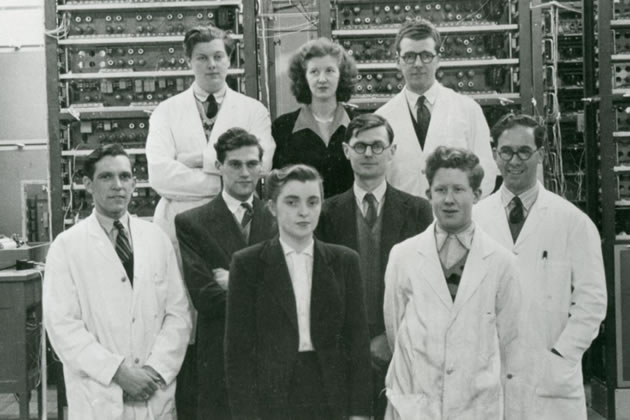
The original Lyons Electronic Office (LEO) team. Picture: LEO Computer
November 16, 2026
A pioneering computer developed by a catering company in Hammersmith, which helped lay the foundations for modern business computing, is celebrating its 75th anniversary amid evidence that its contribution to technology has largely been forgotten.
The Lyons Electronic Office (LEO), developed by J. Lyons & Co. at its former headquarters at Cadby Hall, 66 Hammersmith Road, completed its first full programme on 30 November 1951.
It was the world's first business computer, capable of completing in five hours a task which had previously taken a team of clerks several days.
The story began with J. Lyons & Co., one of Britain's largest catering businesses, better known for its nationwide chain of teashops, cakes and the uniformed waitresses known as Nippies.
The company employed more than 30,000 people and operated hundreds of teashops. It was looking for a more efficient way of managing its increasingly complex business, particularly stock valuations and bakery inventories.
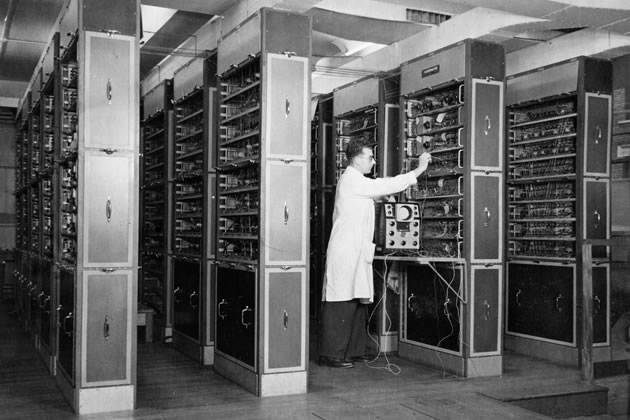
Taken on the 28 January 1953. LEO in development is made of 18 racks of electronic equipment
In 1947, it invested £3,000 in the Mathematical Laboratory at Cambridge University, where mathematician Maurice Wilkes was developing the EDSAC computer.
That investment helped set in motion the development of LEO, which applied computing technology to everyday commercial operations at a time when computers were primarily being used for scientific and military calculations.
LEO subsequently undertook tasks including payroll, invoicing, stock control and order processing, helping establish systems which remain central to business operations today.
Gloria Guy, now 90, who is described as the last remaining LEO I operator, joined the organisation in 1954.
She recalled the distinctive sounds of the machinery and the pioneering nature of the work.
"Even though I joined LEO in 1954, it's vital we recognise that before that day in 1951, every organisation of any size in the world employed teams of clerks to carry out basic business tasks – such as order processing, invoicing, stock control and payroll – by hand.
"After LEO showed the way, the rest of the world followed."
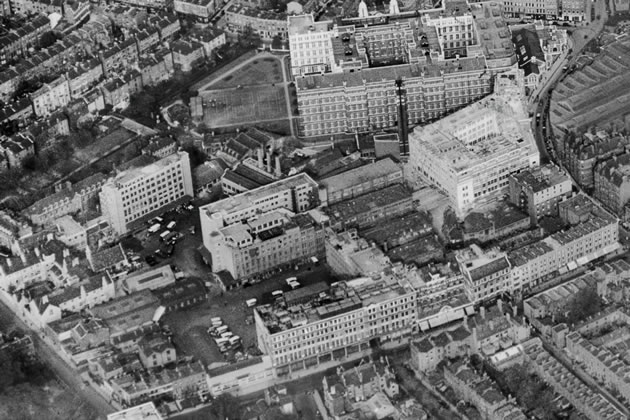
Cadby Hall aerial photograph
Hilary Caminer, daughter of LEO pioneer David Caminer, said the team had to invent systems and design processes from scratch.
She said: "Now that everyone has access to immense computer power in their own hands, it's amazing to see just how much floor space LEO took up: how many valves it used, how its memory had to be constructed out of long, expensive and heavy mercury tubes, and how little memory capacity it had.
"Yet, what it achieved in terms of revolutionising how essential business processes are carried out is pivotal to today's modern business computing world."
New research commissioned by the Leo Computers Society suggests that 80% of Britons are unfamiliar with LEO, while almost three-quarters are surprised to learn that Britain, rather than Silicon Valley, was the birthplace of business computing.
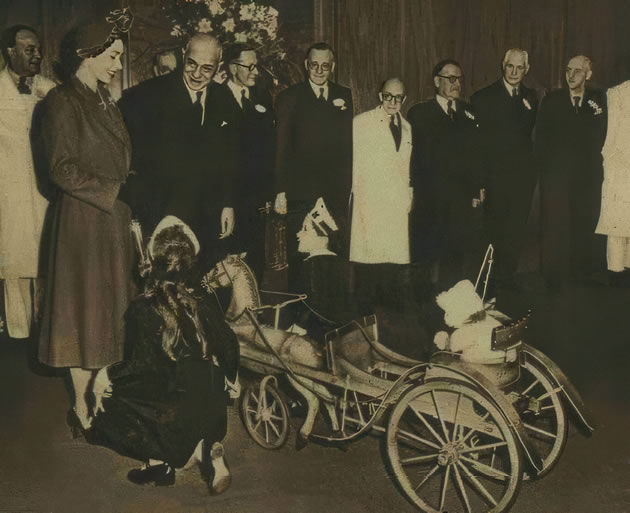 J. Lyons & Co. Management presents Princess Elizabeth with a toy pony and gig for Prince Charles and Princess Anne at Cadby Hall in 1951
The survey of 2,000 people found that 78% could not name a British computing pioneer. Among younger generations, the figure rose to 88% of Generation Z respondents and 73% of Generation X.
The research also found that 69% believed LEO deserved greater recognition for its contribution to computing, while 71% thought its history should be included in the national curriculum
The research found that 86% of respondents were surprised to discover that a catering company famous for its teashops and cakes had built the world's first business computer. Almost half said they were very surprised to learn that a local bakery and teashop business had played such an important role in the development of modern computing.
Georgina Ferry, author of A Computer Called LEO, said the story needed to be told to new generations.
She said: "When I discovered LEO's story, I was as surprised as anyone. I felt strongly that it needed telling for a new audience, and wrote my book for that reason.
"It was a privilege to meet many of the LEO pioneers, most of whom are sadly no longer with us, and hear their personal accounts. They had worked in a state of constant excitement, as every day they were doing something that had never been done before."
Peter Byford, chairman of the Leo Computers Society, said it was worrying that so many people remained unaware of the British achievement.
He said LEO had not only delivered the first commercial computing system but had also introduced systems analysis and design to the wider world.
The survey found that 64% of respondents believed the Government should do more to raise awareness of LEO's legacy, while 41% supported the creation of a National LEO Day.
Byford suggested that this could form part of a wider British Innovation Day celebrating technological achievements which have been overshadowed by the scale and resources of American industry.
Three events are planned between 28 and 30 November to mark the anniversary of LEO's first successful operational run.
On Saturday 28 November, the Centre of Computing History in Cambridge will recreate a 1950s Lyons teashop, complete with Nippy waitresses serving tea and cakes, swing dancers and activities for children and adults.
Visitors will also be able to explore an interactive virtual reconstruction of the LEO computer room.
On Sunday 29 November, the National Museum of Computing at Bletchley Park will host a programme of talks examining LEO's development, its relationship with other early computers and the evolution of computing through to artificial intelligence.
The celebrations conclude on Monday 30 November with an event at the Worshipful Company of Information Technologists in London, entitled Celebrating 75 Years of Business Computing – Which Started with LEO.
The event will include presentations and discussions involving historians, academics and technology experts, chaired by Georgina Ferry.
Further information about LEO and its anniversary celebrations is available at leo-computers.co.uk.
Value Reading Articles Like This? Help Us Produce More This site remains committed to providing local community news and public interest journalism. Articles such as the one above are integral to what we do. We aim to feature as much as possible on local societies, charities based in the area, fundraising efforts by residents, community-based initiatives and even helping people find missing pets. We've always done that and won't be changing, in fact we'd like to do more. However, the readership that these stories generates is often below that needed to cover the cost of producing them. Our financial resources are limited and the local media environment is intensely competitive so there is a constraint on what we can do. We are therefore asking our readers to consider offering financial support to these efforts. Any money given will help support community and public interest news and the expansion of our coverage in this area. A suggested monthly payment is £8 but we would be grateful for any amount for instance if you think this site offers the equivalent value of a subscription to a daily printed newspaper you may wish to consider £20 per month. If neither of these amounts is suitable for you then contact info@neighbournet.com and we can set up an alternative. All payments are made through a secure web site. One-off donations are also appreciated. Choose The Amount You Wish To Contribute. If you do support us in this way we'd be interested to hear what kind of articles you would like to see more of on the site – send your suggestions to the editor. For businesses we offer the chance to be a corporate sponsor of community content on the site. For £30 plus VAT per month you will be the designated sponsor of at least one article a month with your logo appearing if supplied. If there is a specific community group or initiative you'd like to support we can make sure your sponsorship is featured on related content for a one off payment of £50 plus VAT. All payments are made through a secure web site. |
Related links
Chase & Status Provide Hammersmith FC with Graffiti-inspired Kit Sign up for and email newsletter from HammersmithToday.co.uk Comment on this story on the Hammersmith Forum |